Security & Privacy Certifications · Part 1
Jump to prices and budget examples · See Auto-Dat’s difficulty assessment

IAPP illustrates its on-site testing option with these computer workstations. Its scheduling guidance also describes remote delivery. Check the current options and requirements for your selected exam before booking.
Image and exam guidance: IAPP.
Your manager asks you to “take a data protection certification.” You open a comparison table and find CIPP, CIPM, CIPT, ISO 27001 and ISO 27701. Then come Foundation, Lead Implementer and Lead Auditor. Which one actually helps with the work on your desk?
Start with the responsibility you need to handle. Explaining a privacy requirement, designing a safer data pipeline, running a privacy program and implementing a management system are related tasks, but they need different skills. This guide helps you shortlist a path and turn that choice into a concrete learning plan.
The decision that matters
Finish this sentence before comparing certificates: “In the next three months, I need to be able to ______.” A specific deliverable will tell you more than a job title or the word “Lead.”
A quick starting point: explore CIPP for regional privacy rules, CIPM for running a privacy program, and CIPT for privacy in technology. Explore an ISO Lead Implementer path when your assignment is to implement a management system against the relevant standard. The sections below explain the boundaries and help you check the fit.
1. Understand what you are comparing
IAPP is a professional association that awards credentials such as CIPP, CIPM and CIPT. ISO develops standards. When a provider offers an ISO 27701 Lead Implementer qualification, check the organization issuing that personal credential and its certification scheme. IAPP certification overview; ISO’s explanation of certification.
A course completion certificate
Records completion of a training course. Read what was assessed before treating it as evidence of independently examined competence.
A personal professional credential
Recognizes an individual under the issuer’s rules. An exam, experience requirements, an application and ongoing maintenance may be separate steps.
Organizational certification is a separate question. A company can seek certification of a defined management-system scope. One employee passing a Lead Implementer exam does not certify the organization. When an employer says “we need ISO,” ask which outcome they mean. Source: ISO.
2. Match the credential to the work
A DPO, privacy manager, legal counsel, data engineer, security manager or GRC professional may all encounter these paths. Use this table as an editorial shortlist, then read the current syllabus. It identifies a learning gap; it is not a hiring requirement for everyone with the same title.
| Your responsibility | Start by exploring | A useful work output |
|---|---|---|
| Interpret privacy obligations in the markets you support | CIPP concentration matching the relevant jurisdiction | A documented requirements assessment to discuss with legal counsel |
| Coordinate people, processes and measurement in a privacy program | CIPM | A program plan with owners, escalation paths and review measures |
| Build privacy into products, software and data processing | CIPT | A data-flow review covering collection, access, retention and deletion |
| Implement a privacy information management system | ISO/IEC 27701 Lead Implementer | An implementation plan with scope, responsibilities and evidence |
| Implement a broader information security management system | ISO/IEC 27001 Lead Implementer | A security management-system implementation plan |
| Assess a management system against a specified standard | Lead Auditor for that standard | An audit plan and evidence-based findings |
Scope references: CIPP, CIPM, CIPT, PECB ISO 27001 Lead Implementer, PECB ISO 27701 Lead Implementer and PECB ISO 27701 Lead Auditor. The outputs are our suggested practice exercises, not promised course deliverables.
3. When does an IAPP path make sense?
An example from the regional CIPP family.
Graphic: IAPP
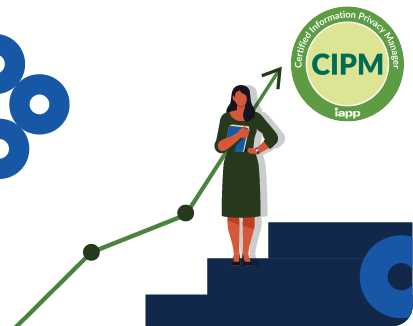
Privacy program management.
Graphic: IAPP
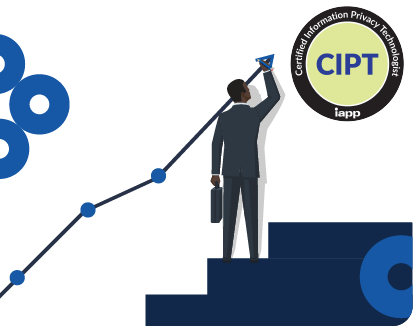
Privacy in technology.
Graphic: IAPP
These provider graphics help you recognize credential names. A seal or badge graphic is different from a personal certificate or a verifiable credential record. They are shown for editorial reference, not as Auto-Dat’s or the author’s qualifications.
CIPP: you need a stronger grasp of privacy rules
Explore CIPP when your work involves understanding privacy laws and practices for a particular region. Choose the concentration by the markets you support. Read its Body of Knowledge rather than assuming a regional name covers every country in that region. Source: IAPP CIPP.
Try this: list the jurisdictions involved in one proposed data use, the questions you cannot yet answer and who must validate the interpretation. Compare those questions with the current exam syllabus.
CIPM: you need to make privacy work across a business
CIPM focuses on establishing and managing a privacy program through its life cycle. Explore it when teams need a repeatable way to coordinate responsibilities and day-to-day privacy work. Source: IAPP CIPM.
Try this: take one request to delete customer data. Write down who receives it, who verifies it, which teams act, how exceptions are escalated and what records show completion. Missing owners point to an operational gap worth investigating.
CIPT: you need to turn privacy requirements into technical decisions
CIPT addresses embedding privacy into technology, products and services. It can be relevant to engineers and architects deciding how data is collected, used and protected. It does not replace expertise in the particular cloud, database or application you operate. Source: IAPP CIPT.
Try this: draw a form-to-database-to-client data flow. For each field, identify why it is collected, who can access it, when it should be removed and where copies may remain. Use the unanswered design questions to assess whether CIPT fits your gap.
4. When does an ISO implementation path make sense?
Consider an implementation path when the assignment is to establish and operate a management system against a specific standard. You need to connect policies, responsibilities, implementation activities, evidence and ongoing review.
ISO/IEC 27001
The Lead Implementer path concerns an information security management system, or ISMS. Explore it when your remit spans organizational information security and its management. Provider scope.
ISO/IEC 27701
The Lead Implementer path concerns a privacy information management system, or PIMS. Explore it when the project is specifically about organizing and managing privacy responsibilities. Provider scope.
Ask your sponsor: “Are we developing my skills, implementing a management system, or preparing a defined scope for organizational certification?” The answer affects the training, project support and budget you need.
Confirm the exact standard edition, syllabus and awarding body. “ISO Lead Implementer” on its own is not enough detail to compare two offers.
5. Foundation, Lead Implementer and Lead Auditor do different jobs
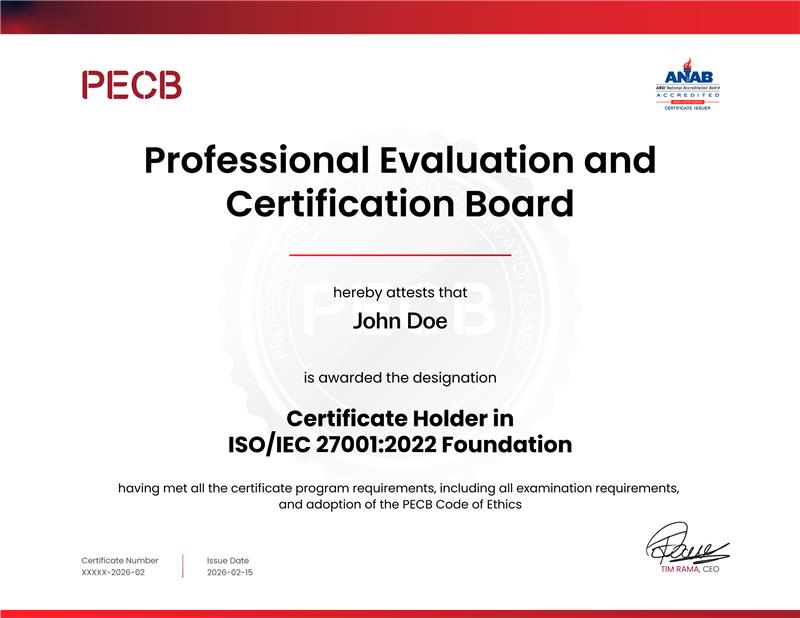
Foundation introduces core concepts. Lead Implementer focuses on putting a management system into practice. Lead Auditor focuses on assessing it. Compare them by purpose rather than treating them as a universal sequence everyone must complete. Check your provider’s prerequisites. Foundation, Lead Implementer and Lead Auditor.
Check eligibility before paying
Under PECB’s published ISO 27701 scheme, the Lead Implementer designation requires the relevant exam, five years of professional experience including two in privacy management, and at least 300 hours of PIMS project experience, alongside its ethics requirement. Provisional Implementer and Implementer have different requirements. Passing an exam and qualifying for the Lead designation are separate checks. Current PECB requirements.
Ask which designation you could receive with your current experience, what evidence the issuer accepts and how progression works. Another provider may use different rules.
6. The same job title can lead to different choices
These illustrative situations are not accounts of actual clients or certification outcomes.
A data manager redesigning a customer pipeline
The team needs to reduce collected fields, restrict exports and make deletion reach downstream copies. If the learning gap is technical privacy design, shortlist CIPT. If the assignment expands into implementing a PIMS across the business, also evaluate ISO 27701 Lead Implementer. The title stayed the same; the responsibility changed.
A privacy lead inheriting disconnected procedures
Teams handle requests and incidents differently. No one owns the handoffs. CIPM is a reasonable first syllabus to examine. Add a jurisdiction-specific CIPP path if interpreting the relevant rules is also a substantial gap.
A security manager assigned a formal implementation project
The sponsor expects an ISMS implementation plan and preparation for assessment. ISO 27001 Lead Implementer is a closer scope to investigate. If the assignment is to assess a management system, review the corresponding auditor path instead.
7. Choose your next action
Open the statement closest to your situation. These prompts help form a shortlist; they do not assess professional competence.
I need to understand which privacy rules apply
Start with the CIPP concentration relevant to your markets.
- Write down the jurisdictions you support.
- Read the current Body of Knowledge and exam blueprint.
- Highlight three topics connected to your responsibilities. Discuss remaining legal questions with the appropriate adviser.
I need teams to follow a repeatable privacy process
Start by reviewing CIPM.
- Choose one process, such as a data-subject request.
- Map its owners, handoffs and evidence of completion.
- Compare the gaps with the syllabus. Agree on one process improvement as a learning outcome.
I need to make a product or data flow more privacy-aware
Start by reviewing CIPT.
- Draw one data flow using field names rather than real personal records.
- Mark the decisions you cannot yet justify.
- Compare those decisions with the syllabus and choose one design review to complete during your study.
I need to implement or assess a management system
Identify the standard and your project role first.
- Confirm whether the scope concerns information security, privacy, or both.
- Separate implementing the system from independently assessing it.
- Check the issuer’s standard edition, prerequisites and exact credential eligibility before selecting a course.
8. What will learning, exams and maintaining the credential cost?
Prices checked on 12 November 2026, in US dollars. The examples below identify the seller and delivery format. They are public listed prices, not a universal market rate or a checkout quote. Applicable tax, currency conversion and optional materials can add to your bill.
IAPP: separate tuition from the exam and activation
| Credential and training example | Learning / tuition | Exam | Getting the credential active | Keeping it active |
|---|---|---|---|---|
| CIPP/A · Straits Interactive international live-online package | US$2,000 package; tuition is not separately itemized | One sitting included. Standalone IAPP exam: US$550 | Package includes first-year membership for new IAPP members; confirm activation coverage with the provider | After included coverage: CMF US$250 / 2-year term, or membership US$295 / year |
| CIPP/E · IAPP online training | US$1,195 non-member / US$995 member | US$550, separate from this training purchase | US$250 CMF for the initial two-year term, or covered by active membership | US$250 / 2-year term, or US$295 / year membership |
| CIPM · IAPP online training | US$1,195 non-member / US$995 member | US$550, separate | US$250 initial-term CMF, or active membership | US$250 / 2-year term, or US$295 / year membership |
| CIPT · IAPP online training | US$1,195 non-member / US$995 member | US$550, separate | US$250 initial-term CMF, or active membership | US$250 / 2-year term, or US$295 / year membership |
Training sources: CIPP/A package and inclusions, CIPP/E, CIPM and CIPT. Exam sources: CIPP/A, CIPP/E, CIPM and CIPT. The CIPP/A package lists GST as additional where applicable; its new-member benefit is not a promise of four years of membership.
Do not pay for the same coverage twice
IAPP’s US$250 CMF activates the credential and covers a two-year certification term. Do not add another US$250 “certificate issuance” charge on top of that same initial term. An active membership includes the CMF benefit, so membership and CMF are alternative maintenance routes. IAPP also requires continuing education; budget time and any chosen paid activities. CMF terms; maintenance rules.
Two IAPP budget examples
- Self-study, one first-time US$550 exam, non-member CMF route: US$550 + US$250 = US$800 for exam and initial-term activation/maintenance. Add your study materials. Across two consecutive two-year terms, the same fee assumptions give US$550 + US$250 + US$250 = US$1,050 over four years.
- One official US$1,195 online course plus that exam and CMF route: US$1,195 + US$550 + US$250 = US$1,995 initially; with the next US$250 term, US$2,245 over four years.
These calculations assume passing the first sitting, unchanged prices, one credential and no annual membership. They exclude taxes, retakes, extra books, practice tests and paid continuing education. A self-study tuition line of US$0 means no paid course was purchased, not that every learning resource is free. Do not apply these totals to the bundled CIPP/A package.
PECB: identify what the course package already includes
| Course example | Learning package | Exam charge in this package | Certificate/application charge | Maintenance |
|---|---|---|---|---|
| ISO 27001 or ISO 27701 Foundation · Mindset Cyber eLearning | US$279 each | Included; US$0 extra | Included; US$0 extra | Foundation has no AMF under the cited PECB policy |
| ISO 27001 Lead Implementer · Mindset Cyber US eLearning | US$589 | Included; US$0 extra | Included; US$0 extra | First year included; full Lead credential policy rate US$390 / 3-year cycle |
| ISO 27701 Lead Implementer · same provider/format | US$589 | Included; US$0 extra | Included; US$0 extra | First year included; full Lead credential policy rate US$390 / 3-year cycle |
Sources: provider course price list, individual US 27001 course and 27701 course; PECB maintenance policy. These packages include two exam attempts subject to their terms. The combined package price is not an itemized tuition-only price. Other providers, delivery formats and exam-only purchases have different prices.
For a Lead credential, the US$589 package is the illustrated upfront payment, not the lifetime cost. Ask how the included first maintenance year is credited and when the remaining fees fall due. PECB’s US$390 is a three-year cycle rate, not US$390 every year. Meet the applicable CPD requirements as well. Certificate eligibility still depends on your experience.
Your action: obtain a written quote with four rows: tuition, exam, credential application/activation, and maintenance. Mark each “separate payment” or “included,” then add tax and optional items. For multiple IAPP credentials, check CMF coverage before multiplying that fee by the number of certificates.
Auto-Dat difficulty assessment
Provisional editorial estimates, 1–5. Our reference learner works in data or analytics, understands basic access controls and data flows, but has no formal privacy-law training or management-system implementation experience. We consider legal/standards reading, concept breadth and the amount of scenario-based application. A score of 2 suggests introductory preparation, 3 focused study and 4 substantial preparation. These are comparisons, not predicted pass probabilities.
| Path | Auto-Dat study estimate | Why / what to do first |
|---|---|---|
| CIPP/A | 4/5 · substantial | Regional legal distinctions may be unfamiliar to a technical learner. Compare the covered jurisdictions before studying. |
| CIPP/E | 4/5 · substantial | Legal interpretation adds to terminology learning. Read the current Body of Knowledge and work through practice scenarios. |
| CIPM | 3/5 · focused | Program ownership and operational decisions go beyond definitions. Map one existing process and its handoffs. |
| CIPT | 3/5 · focused for this learner | Technical experience helps, but privacy design is still a distinct discipline. Review a real data flow against the syllabus. |
| ISO 27001/27701 Foundation | 2/5 · introductory | Start with management-system vocabulary and the particular standard’s purpose. |
| ISO 27001/27701 Lead Implementer | 4/5 · substantial | Connecting requirements, risk, implementation and evidence is broad work. Define a small implementation project first. |
Assessment reviewed 12 November 2026 against the official scopes linked in this article. It is not based on first-hand exam attempts, pass-rate data or a candidate survey. A legal professional may find the CIPP paths easier; a non-technical learner may find CIPT harder. Experience-based eligibility is a separate gate: a study score does not mean you qualify for the Lead designation.
9. Leave with a one-page decision
Copy this template into your notes and use it with your manager or training sponsor. Keep confidential project details out of public examples.
My main responsibility:
The deliverable I need to produce in the next three months:
The knowledge or skill gap blocking it:
My first credential shortlist:
The syllabus topics that match my gap:
The issuer, standard edition or regional concentration:
The exact credential I am currently eligible to receive:
The experience or evidence I still need:
Total quoted cost, inclusions and renewal obligations:
Study time available each week:
The person who will review my practical work:
My next action and date:
If you cannot name a work output yet, arrange that conversation before booking an exam. If an employer or contract requires an exact credential, confirm its wording and issuing body before comparing alternatives.
Your next move
Choose a responsibility. Shortlist a credential. Plan the work.
Today, write your three-month deliverable and read the official syllabus for your closest match. Then check eligibility and request a complete quote. You will have a decision you can explain to an employer and a way to judge whether the learning is useful.
Sources and editorial notes
Provider information checked on . Scope descriptions and requirements link to the issuing organizations throughout. Career-fit suggestions, scenarios and worksheets are Auto-Dat editorial guidance. This is a researched decision guide, not a first-hand course review.
The linked PECB schemes are examples of a named provider’s personal qualifications. Check the exact scheme you intend to purchase. This guide covers selected privacy and management-system paths rather than the full cybersecurity certification landscape.
Related reading: data pipeline architecture.
Put your ISO 27001 learning into practice
Work through twelve guided chapters with 240 original questions, explanations and practical exercises. Begin with the ISMS and CIA triad, then build toward risk treatment, audit and an integrated final case.
Start Chapter 1: ISMS and the CIA triad · Browse all twelve ISO 27001 practice chapters
Independent Auto-Dat learning practice, not official exam questions or a certification award.